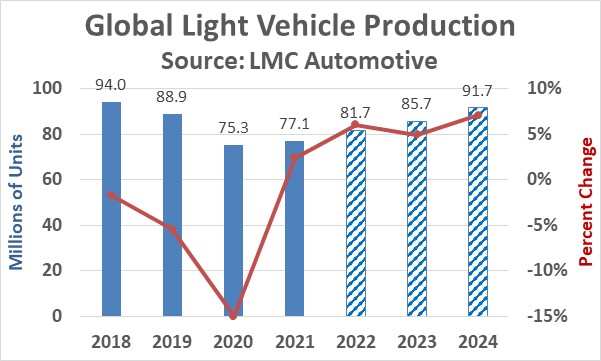
On September 15, 2022, during a TV morning show appearance, General Motors CEO Mary Barra predicted the current device shortage will continue through 2023 and possibly beyond. “It’s getting a little better, but I frankly think it’s something that’s going to last into next year, maybe a little beyond,” says Ms. Barra.
GM recently paused Silverado production for a week at the Silao plant where 8,000 people are employed.
In June, GM declared that its Buick-brand vehicles will go fully electric by 2030. Fully Electric Vehicles (EV) have an even higher percentage of microchips than their gasoline-powered cousins, which much be addressed, as well as infrastructure such as recharging stations.
Microchip shortages are more complex than simpler parts. Each programmable device requires a value-added program uploaded to add functionality. Therefore, it’s not as simple as ordering more devices, but also allocating programming services (which can be outsourced or done in-house in a variety of ways– See the top 5 ways here).
Most automotive companies continue to experience shortages of critical parts and components, driven by supply chain issues since 2020. In an excellent article from Electronics Weekly, titled “Auto chip shortage could be easing,” David Mannerspoints to several signs the shortages of semiconductors may be behind us in the next year.
Causes of the chip shortages
From the article, here are some of the reasons for the global automotive shortages
Automotive manufacturers cut back on semiconductor orders severely at the beginning of the COVID-19 pandemic in early 2020. The auto companies were fearful of being stuck with excess inventories of cars if demand fell significantly due to the pandemic. When the automakers tried to increase orders, they had lost their place in line and were behind other industries such as PCs and smartphones.
Many automakers used a just-in-time ordering system to avoid excess inventories. This left them with almost no buffer inventories. Also, most semiconductors used in automotive are bought by the companies supplying the systems (engine controls, dashboard electronics, etc.) rather than the automakers, leading to a more complex supply chain.
Semiconductors used in automobile production have long design-in cycles and must be qualified; thus, it is difficult for an automaker to change suppliers in the short term.
The article looks at all the big automakers and their prospects for returning to full production; it also highlights what the semi-houses are doing to ramp up to meet demand. Learn more about how BPM manufactures all its systems in their ISO 9001:2015 certified plant located in Houston, Texas; find out how BPM makes device programming easy, fast, and affordable at www.bpmmicro.com/device-programmers.
BPM provides equipment and accessories to upload custom programming to semiconductor devices. Founded in 1985, BPM Microsystems serves more than 2,000 companies in over 49 countries. BPM programmers offer high-performance device handling, advanced serialization, and quality control, meeting the highest programming and cybersecurity standards for automotive, aerospace, medical, industrial, and mobile device applications. BPM’s intelligently designed systems deliver the lowest programming cost per device.
Back in 1985 in a dorm room at Rice University, Bill White founded BP Microsystems (later BPM Microsystems). He couldn’t find a decent chip programmer for a class project he was working on, so he made his own. He started to sell the EP-1, an E/EPROM programmer, locally and then by mail order; the rest is history. BPM still builds all of its systems in Houston, Texas.
Interview with Scott Bronstad, Digital Marketing Manager at BPM Microsystems.
Easy Engineering: What are the main areas of activity of the company?
Scott Bronstad: BPM designs and manufactures universal programming systems and supports them with algorithms and socket adapters (software and hardware) to program specific devices. BPM’s catalog of supported devices is in excess of 70,000, including both legacy and cutting-edge technologies. Newer and faster versions are continually added on an almost daily basis. BPM serves electronics manufacturers worldwide including OEM, ODM, EMS, and programming centers. Industries that utilize BPM programming solutions include Automotive, Healthcare, Aerospace/Defense, Industrial, IoT/Industry 4.0, and Cybersecurity.
E.E: What’s the news about new products?
S.B: BPM has “generations” of products with specific site technology. The “site” is the magic of BPM programmers, and sockets/algos make them the most “universal” of device programmers. Universal, as opposed to single-use, allows the systems to be configured to support thousands of devices on hundreds of different socket adapters. BPM pioneered socket adapter technology with active circuitry that delivers clean signal integrity and high yield.
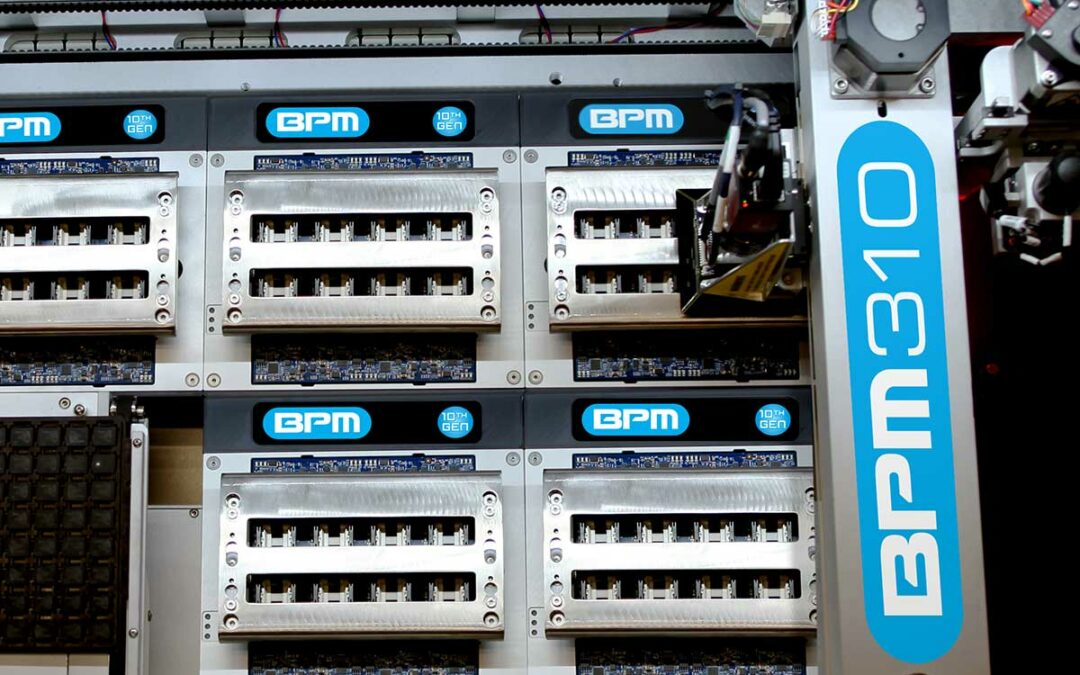
The latest generation of BPM sites is 10th Gen. 10th Generation site technology offers the broadest support in the industry at unsurpassed programming speeds.
The newest Automated Programmer, the BPM310, comes with up to six 10th Gen sites providing full universal support for UFS, eMMC HS400, MCU, NAND, and Serial Flash, at incredible speeds with up to 48 devices programmed concurrently. It is the most capable programmer in a small footprint. For UFS 2.1, each site can program eight devices at a time, at up to 440 MB/second read and 201 MB/second write (industry best).
BPM is pleased to announce the hire of a dedicated Field Service Engineer to cover Mexico from Reynosa on the Texas border. Alejandro Puebla is an accomplished STM Process Engineer with over 10 years of experience. He has worked on and maintained BPM automated programmers for an Original Equipment Manufacturer in Reynosa prior to joining BPM full-time. He will give BPM the ability to service customers locally, in addition to troubleshooting technical issues, and is fluent in both Spanish and English.
With Alejandro on board, BPM now has three levels of support for its Mexico clients, including BPM Field Service Engineers in Houston, Texas. “Mexico continues to grow in international manufacturing,” says Penny Santhanam, Director of Customer Care at BPM. “Alejandro has the experience with working on the line locally– he understands the needs and challenges unique to device programming, and will be a huge asset for the growing number of companies with BPM systems.”
If you would like to learn more about BPM, or have a service or technical-related question, please call +1 (713) 688-4600, toll-free in the US at (855) SELL BPM, or 24/7 Service hotline* at +1 (832) 617-5702. You can also email technical support attech@bpmmicro.com.
*After-hours calls are complimentary for clients with current hardware contracts.
BPM Microsystems announces the sale of an Automated Programming System to a Contract Manufacturer*. This electronics manufacturing service company has standardized BPM solutions for its in-house programming support for the last 15 years. They are still running 6th Generation Automated Programmers in their factory in Mexico. They are expanding and bought a BPM 3928 to support their growing demand. The 3928 purchased is fully loaded (six sites, tray stacker, tape in/out, fiber laser.).
3928 9th Generation Automated Programmer
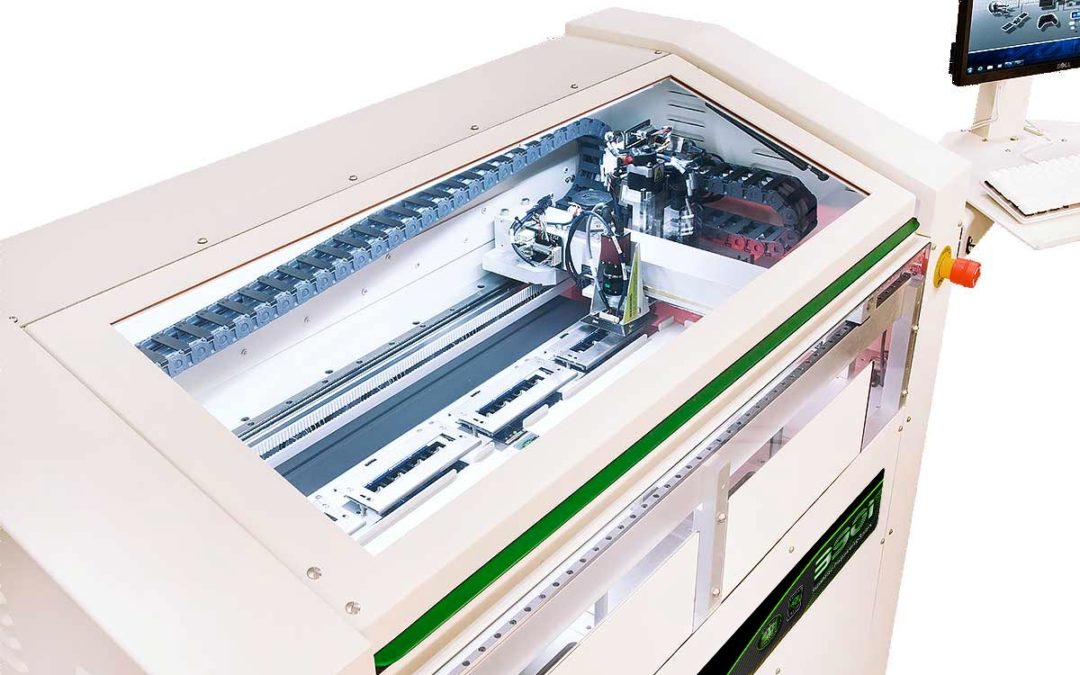
The 3928 Automated Programmercan program up to 28 devices at a time, at up to 1,432 devices per hour. It comes standard with WhisperTeach™ automated Z-Height teaching for fast, reliable set-ups, and the CyberOptics LNC120 camera for component auto measure (fast set-ups) and on-the-fly alignment for maximum first pass yield and throughput. The 3928 is outfitted with the TM-50 Tape Loading system, the BPM TS-1500 Tray Stacker, and the latest 3000-Series Fiber Laser, capable of producing machine-readable QR codes and barcodes for ultimate component traceability. The BPM laser system is equipped with a two-stage dust collection system that is second-to-none in offline programmers.
Universal Device Programmer
BPM’s 9th Generation programmers are “universal;” they support over 41,000 devices, with nearly daily additions. Instead of requiring different site technologies, BPM utilizes one platform for all device technologies, such as MCUs, eMMC HS400, NAND, NOR, and Serial Flash devices, and programs both high and low voltage devices. This is especially important for EMS companies because they need a solution that will support present and future projects.
“These customers have a choice when they buy systems and they know our products well. Their vote of confidence says a lot about the productivity and quality they achieve and our ability to keep them happy,” says William White, CEO, and founder of BPM Microsystems.
With over 40 years of heritage in electronic manufacturing services, this contract manufacturer focuses on low-medium volume/high-mix, high-complexity products primarily in the defense/aerospace, industrial, medical device design, and manufacturing field. Their new automated device programmer will greatly increase throughput and enable newer, denser devices for the latest gadgets.
BPM manufactures all its systems in their ISO 9001:2015 certified plant located in Houston, Texas, and its products carry the CE Mark. To learn how BPM makes device programming easy, fast and affordable, go to www.bpmmicro.com/device-programmers/.
BPM Microsystems announces the sale of another Automated Programming System to an Original Equipment Manufacturer. “This is fantastic news and an especially strong sale considering the economic backdrop right now,” says William White, founder and CEO of BPM Microsystems. The second system is a testament to the first machine purchased a little over a year ago. This US-based company creates power systems solutions for a worldwide customer base. “They liked the flexibility and productivity they achieved from the first machine. They bought a second machine for another factory so they can have the same capability there,” says Mr. White.
Unlike other cybersecurity solutions that are expensive and inflexible, BPM offers a range of options based on your particular needs. BPM.NCRYPT can integrate with your existing security systems and can be customized to the unique requirements of the project. It’s scalable: no requirement for a separate HSM for each automated system; One HSM (or secure server) can support several BPM high-speed programming systems. Most of all, it’s affordable: BPM does not charge per device, and all BPM automated systems are enabled to support encryption.
WhisperTeach™
Patented WhisperTeach™ automated Z-Height teaching is ideal for fast, reliable set-ups. In addition, WhisperTeach™ eliminates common Z-height errors such as miss picks, miss place, and socket continuity flaws.
Very small devices such as WLCSP, SOT, and DFN have very low mass. Legacy teaching methods rely on operator skill and vacuum to determine the pick location. When teaching Z with a vacuum, parts often “jump” up to the nozzle, resulting in an inaccurate Z axis pick location. Because automated systems are extremely consistent, a less-than-perfect pick height location will cause pick and place errors, dropped parts, cracked parts, and continuity errors. Damaged devices may pass initial inspection, but could lead to premature failure in the field. WhisperTeach™ eliminates all of these failures by accurately teaching the pick position to within 15 microns of accuracy.
BPM manufactures all its systems in their ISO 9001:2015 certified plant located in Houston, Texas, and its products carry the CE Mark. To learn how BPM makes device programming easy, fast and affordable, go to www.bpmmicro.com/device-programmers/.




 BPM is pleased to announce the hire of a dedicated Field Service Engineer to cover Mexico from Reynosa on the Texas border. Alejandro Puebla is an accomplished STM Process Engineer with over 10 years of experience. He has worked on and maintained BPM automated programmers for an


 BPM.NCRYPT

 The CyberOptics© LNC120 camera is used for component auto measure (fast set-ups) and on-the-fly alignment for maximum first pass yield and throughput. With component auto measure and precision alignment, components as small as 0402 resistors can be aligned with fine precision. Unlike our competitor’s on-the-fly cameras, BPM’s CyberOptics camera has twice the resolution, allowing for faster, more precise auto-correction for the highest quality at the fastest throughput. Above all, it allows the 3901, 3928, and BPM310 to handle the smallest chip-scale package (1.0mm x 0.5mm) to the largest fine-pitch QFP (34x34mm).