+1 (713) 688-4600 | Sales Toll-Free: (855) SELL BPM | 24/7 Service: +1 (832) 617-5702 info@bpmmicro.com
Select Page
35 Years of NAND Flash Memory

35 Years of NAND Flash Memory

35 Years of NAND Flash Memory

2022 marks the 35th anniversary of the invention of NAND flash memory. NOR Flash memory was invented by Dr. Fujio Masuoka while working for Toshiba in 1984. NOR-based flash has long erase and write times but has a full address/data (memory) interface that allows random access to any location. This makes it suitable for the storage of program code that needs to be infrequently updated, such as a computer’s BIOS or the firmware of set-top boxes. Its endurance is 10,000 to 1,000,000 erase cycles. NOR-based flash was the basis of early flash-based removable media; Compact Flash was originally based on it, though later cards moved to the cheaper NAND flash.

NAND flash was born out of a joint venture with Samsung and Toshiba and followed shortly thereafter. It has faster erase and write times, higher density, lower cost per bit than NOR flash, and ten times the endurance. However, it is most suitable for mass-storage devices such as PC cards and various memory cards because of its sequential write and is less useful for computer memory.

BPM has been around slightly longer than NAND Flash and has developed solutions for some of the particular challenges of programming flash devices. See the Flash white papers below.

KIOXIA Celebrates the 35th Anniversary of Invention of NAND Flash Memory


SAN JOSE, Calif., February 10, 2022 – What do the MP3 players of the 1990s and today’s smartphones have in common? Neither would exist were it not for NAND flash memory, an innovation whose influence has reverberated throughout the decades. KIOXIA America, Inc. today announced that it has reached a new milestone – 2022 marks the 35th anniversary of the company’s invention of NAND flash memory.

NAND Flash Video

A new humorous video series from KIOXIA, that explores life without flash memory, kicks off with a look at cloud computing

Flash Memory White Papers

Signal Integrity

Signal Integrity

Not all programming solutions are the same. If quality and maximum device life are important, it’s imperative to know what to look for. When evaluating a programming solution, ask about signal integrity. Review this white paper for helpful tips.
Mastering eMMC Device Programming

Mastering eMMC Device Programming

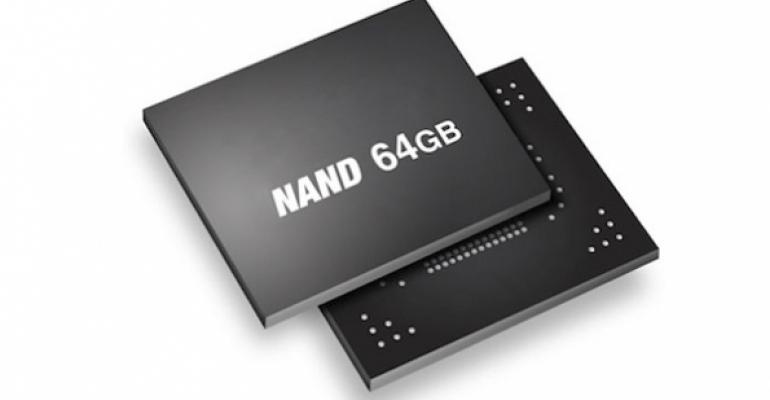
Over the past decade, the demand for high-density, nonvolatile memories with a small footprint has increased dramatically. Two of the most popular markets driving this demand are handheld devices and automotive. Demand for handheld devices continues to drive the research for high-density, low power, low-cost, high-speed, nonvolatile memories while maintaining a small footprint. NAND-type flash memory is the perfect match for such a market. The increased consumer demand for high-tech features in automobiles, such as infotainment systems, is also a big driver of demand for high-density NAND-based devices.
Understanding NAND Flash Factory Programming

Understanding NAND Flash Factory Programming

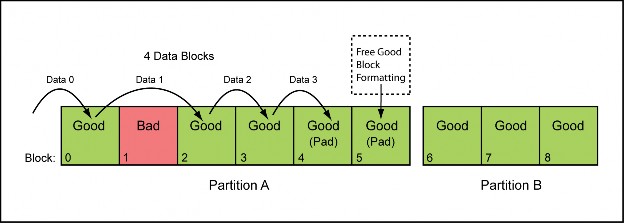
During the manufacturing of electronic systems, blank non-volatile devices must often be programmed with initial data content. This allows the target system to get up and running, and is referred to as “factory programming,” “factory pre-programming,” or “bulk programming.” Generally, this is a very straightforward process that has been in place in the industry for many years. However, with NAND flash the process is more difficult.
New HS400 Device Support for SanDisk, SK-Hynix

New HS400 Device Support for SanDisk, SK-Hynix

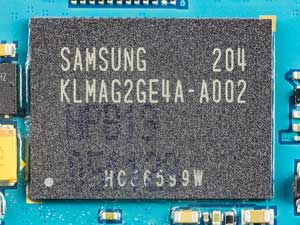
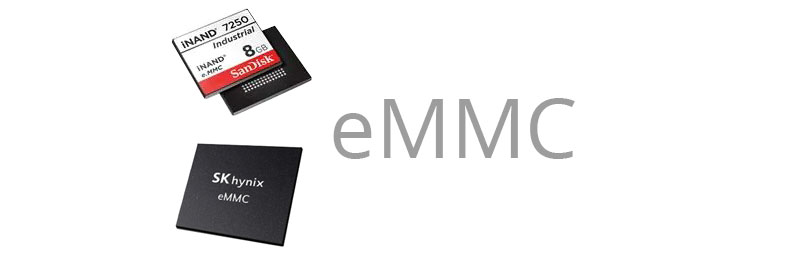
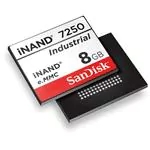
SANDISK SDINBDG48GXIBPM Microsystems is pleased to announce new device support for SanDisk and Hynix eMMC devices with significantly faster HS400 protocol
SanDisk SDINBDG4-8G is an 8GB iNAND Flash Storage device primarily for connected and autonomous cars. Western Digital, the maker of SanDisk, describes this family of flash devices: “Leveraging enhanced flash storage technology for superior reliability, the new iNAND storage devices are designed to support data demands of the latest Advanced Driver Assistance Systems (ADAS). These include cutting-edge infotainment, navigation, HD mapping, V2V/V2I communication, drive event recorders, and autonomous driving. The iNAND EFDs (Embedded Flash Drives) delivers dependable performance even in the most extreme environmental conditions, including ambient temperatures ranging from -40°C to 105°C. Western Digital’s robust iNAND embedded flash drives are ideal for a wide range of connected automotive systems and environments. All of our automotive solutions are AEC-Q100 qualified and are designed to meet the reliability requirements of the automotive industry.”

Typical applications and workloads for the SDINBDG4 are Advanced Driver Assist Systems (ADAS), Navigation / Infotainment, HD Mapping, V2V/V2I Communication, Digital Cluster, Drive Event Recorders, Autonomous Drive, and more.

  • Package: BGA(153)
  • Device Type: eMMC
  • Algorithm Programming Mode: HS400
  • Maximum Interface Speed: 400MB/second
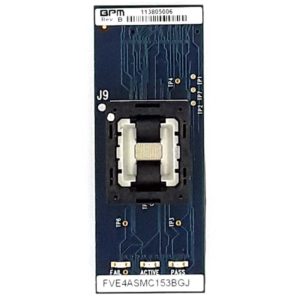
  • 9th Gen Socket Solutions: FVE4ASMC153BGJ, FVE4ASMC153BGZ*
  • Available on BPWin Versions released after 02/03/2021

Hynix

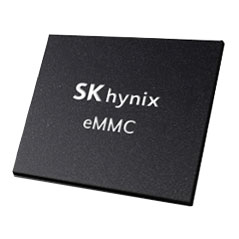
Hynix Semiconductor H26M41208HPRQHynix Semiconductor H26M41208HPRQ is an 8GB eMMC device in a standard FBGA153 package.  The “Q” version is specifically designed for Automotive applications requiring greater temperature ranges. Hynix describes their eMMC 5.1 device family as a “wide-ranging lineup with longevity of support.” It delivers optimized performance with a maximum interface speed of 400MB per second.

  • Packages: BGA(153)
  • Device Type: eMMC 5.1
  • Algorithm Programming Mode: HS400
  • Maximum Interface Speed: 400MB/second
  • 9th Gen: FVE4ASMC153BGJ, FVE4ASMC153BGZ*
  • Available on BPWin Versions released after 03/11/2021

HS400

While BPM has supported both of these devices in the past, HS400 enables programming eMMC devices at greater speeds (up to 400MB/Second) with improved throughput. From our research, we found other device programming companies also (mostly) support these devices, but they don’t mention HS400, so it’s safe to say they don’t support it.

9th Gen

9th Generation Site Technology delivers the fastest programming times, 2 to 9 times faster for flash devices. Vector Engine Co-processing with BitBlast now supports HS400. BitBlast offers the fastest programming speeds in the industry, vastly increasing throughput for high-density managed NAND devices that utilize the eMMC interface.

BPM Advantages

The two socket cards specified (FVE4ASMC153BGJ [available to purchase on the web**] & FVE4ASMC153BGZ) both have compression-mounted sockets. This means when the socket wears out, simply remove it and replace it with LSOCB169KA-3-MOD, rather than replacing the whole socket card (adapter). Both BPM sockets allow for up to 4 devices to be programmed in parallel and will work with both manual and automated systems. In contrast, Elnec’s socket solution is only one-up per programmer, it doesn’t utilize HS400, and they don’t have an automated solution.

BPWin Software Support

In order to fully take advantage of new device support from BPM Microsystems, you’ll need the latest version of BPWin, BPM’s process software. All engineering manual programmers (they start with a “1” such as the 1710) come with lifetime software support. New programmers come with one year of software support; if your software contract has lapsed, please contact Inside Sales to take advantage of daily additions and improvements in device support.

Device Search Socket Decoder Types of Programmables


*FVE4ASMC153BGZ uses a newer board design optimized for HS400; allows for even cleaner waveforms, with higher potential yields
**FVE4ASMC153BGJ is available for purchase online in the US, Mexico and Canada


Number of Devices Supported by 9th Gen

Complete Ecosystem

BPM Microsystems has ownership of all designs, manufacturing, and support for all programming sites, robotics, vision systems, and software, so we can provide unmatched support and responsiveness

  • Reduce your time to market by doing New Product Introduction/First Article through Automated Production with the same hardware, algorithms, and software

9th Generation Site Technology

Manual Programmers for this Device

Available for purchase in North America (US/Canada/Mexico)

Signal Integrity

Signal Integrity

Signal Integrity

A “green light” doesn’t always mean the part is programmed correctly

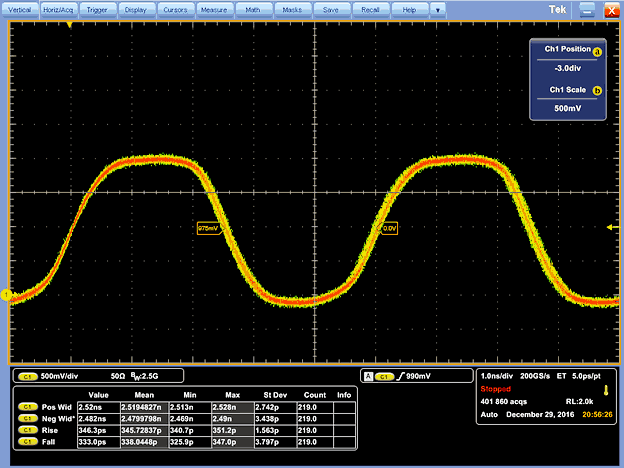
High quality signals, Examples: Free-Running Clock (200MHz)

Have you ever had an electronic item that sometimes glitches or just stops running? Yes, you checked the batteries; it’s plugged into the wall— yet, nothing. It may not be you… You may be experiencing amnesia.

When a device loses its pattern, it’s called amnesia. Sometimes it’s called a bit-flip. It may start with just an occasional failure to boot up, but then progresses until the gadget won’t work at all. To understand how this can happen, let’s talk about how data is actually stored. 

It may surprise you, but device programming is actually (more or less) analog. The basic building block of all code is a bit. Bits form bytes, and bytes form the foundation for most code. Bits are “1” or “0”, but to get that “bit” of information, we actually start much smaller—electrons.   

When programming a serial flash device or MCU, every bit we store in the device is stored on a floating gate MOSFET transistor. The floating gate transistor, which is the basis of every flash device, is inherently an analog device. To get a “1” bit means it has more than a certain number of electrons stored on the gate; a “0” bit means it has fewer than that certain number. In between the “0” and the “1” lies a region of uncertainty— where the bit is going to read as a “1” sometimes and a “0” other times (not good).

Electrons are lost during the years that the device is in service due to ionizing radiation, such as gamma rays (even normal sunlight). If there are not enough electrons stored on the floating gate during programming, the device can lose its memory prematurely. 

Device Life Depends on Signal Integrity

Most devices today are rated for 20 years of data retention. But, if not properly programmed, data may be lost after just a few hours, months or years, even if the device passes the initial “green light” verification.

Programmers must go to great lengths to ensure signal integrity when programming devices. It requires specialized hardware that is typically not found in less expensive programmers. The acid test— can the programmer program and test the most challenging devices, such as the AMD PALs, which are notoriously “challenging,” or antifuse FPGAs, where a single device can cost upwards of $100K each. In programming devices, it’s vital to meet every specification of the device being programmed to avoid bit flips. 

Controlled impedance traces on the PCBs are critical to signal integrity. Controlled impedance is the characteristic impedance of a transmission line formed by PCB conductors. It is relevant when high-frequency signals propagate on the PCB transmission lines. Controlled impedance is important for signal integrity: it is the propagation of signals without distortion.  Boards should be thoroughly tested in-house on a high-dollar oscilloscope before manufacturing. Not all of our board vendors make the grade. The problem gets down to overshoot and ringing, undershoot and rise times, and noise on these edges, set up and hold times— all these specs have to be met, or the quality of the part may prematurely degrade. 

The Green Light

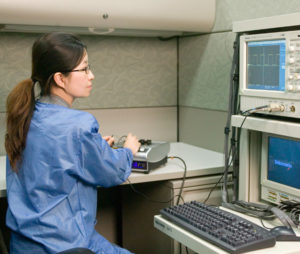
The green light on the socket indicates the programmer was able to verify the part. Unfortunately, it may not mean the programmer is meeting all of the device requirements. Waveform integrity has to be verified with an oscilloscope, not just the green light — it’s about meeting the specs of the device with clean waveforms for maximum quality and life expectancy. 

Each part you are programming was tested and qualified on a “million-dollar” tester at the Semi House to ensure it works correctly. The device manufacturer guarantees the part will work if you meet the parts specifications. They do not test the part to ensure it will work with overshoot, ringing, ground bounce, VCC noise, ground noise, crosstalk, substrate noise, low edge rates, no bypass capacitor, setup violations, hold time violations, shorter than required programming pulses and other signal integrity problems.

When a device is programmed with inferior waveform quality, it effectively becomes a “test pilot.” How long will the data be retained? Nobody knows. It has never been tested and qualified in those conditions. Even if it passes today, that doesn’t mean it will continue to work in-circuit, with variations in voltage, temperature, timing, and the inevitable decay caused by continual bombardment from solar and terrestrial radiation sources. 

One more thing to look for is “hard gold” on the PCBs. Hard gold is an extra layer of quality to ensure low resistance contacts, especially on socket cards connections between the PCB and socket. It also ensures solder connections that won’t oxidize.


The Bottom Line

  • Many cheap programmers are available that don’t pay attention to signal integrity
  • Just getting the green light on is not the same as programming the DUT correctly. It does not ensure good signal integrity.
  • When you don’t meet the device specs, you become a test pilot. You are operating the device in conditions it has never been tested to handle. Your results are unpredictable.
  • Devices can get amnesia days, months or years after programming if the programmer has poor signal integrity
  • Programmers with 2-layer boards, dip adapters and no active circuitry by the socket are highly suspect 

To Ensure Signal Quality

  • Pin drivers  must be are accurate enough to meet the stringent demands of eMMC programming at HS400 with 600ps rise time and fall time
  • Utilize premium 3GHz controlled-impedance connectors on every socket adapter 
  • Design using controlled impedance multi-layer PCBs right up to the socket to maintain signal integrity
  • Test the waveform accuracy and impedance of circuit boards to ensure signal integrity
  • Sophisticated Oscilloscope tests should be used to confirm performance, rise time and signal integrity

Conclusion

Not all programming solutions are the same. If quality and maximum device life are important, it’s imperative to know what to look for. When evaluating a programming solution, ask about signal integrity. Go through the device specifications and demand evidence that all of the specs are being followed.